Written and Reviewed by: Health Decoded / Last updated: September 2026
You wake up in the morning and notice something different.
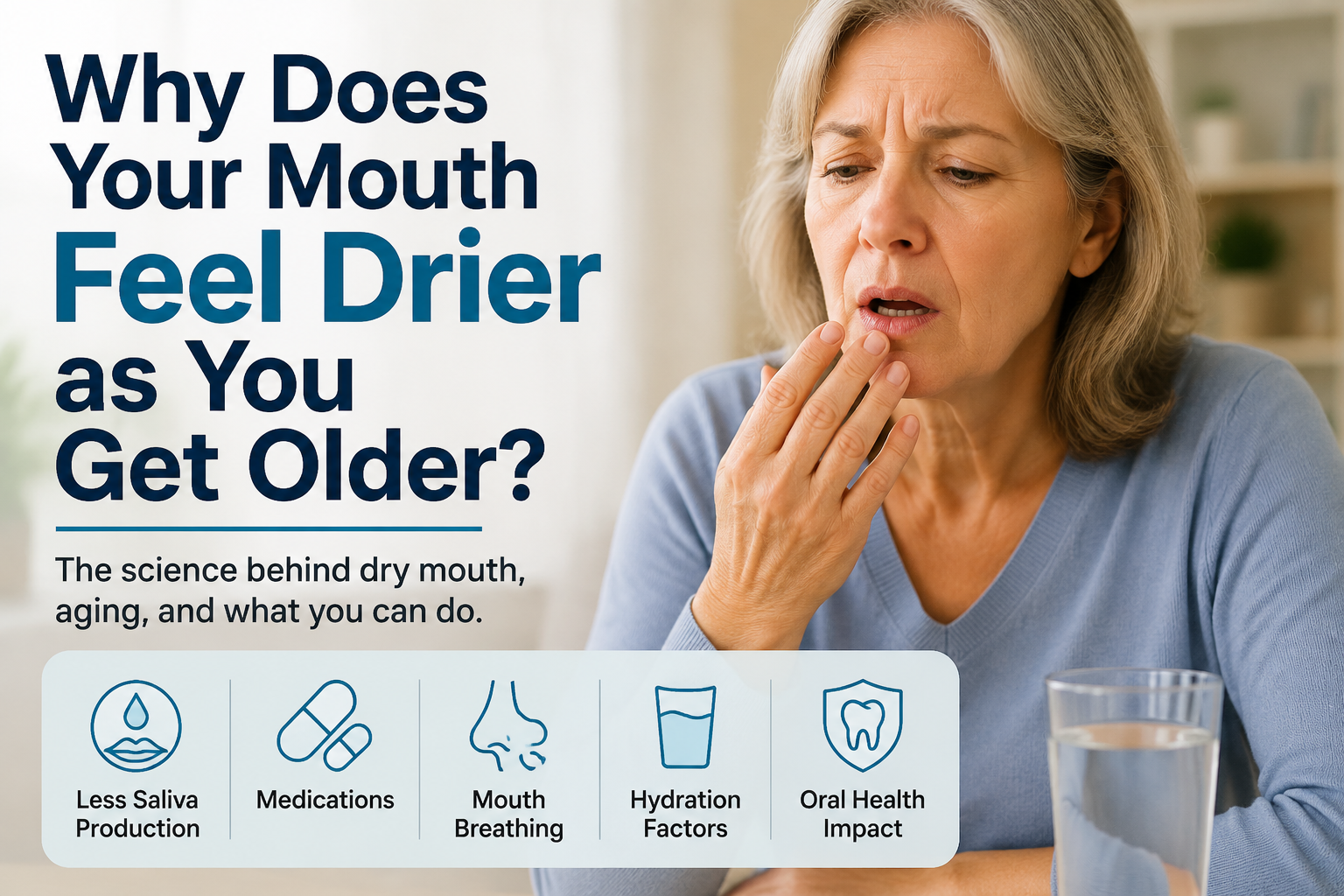
Your mouth feels dry.
Your throat feels slightly uncomfortable.
Talking for a long time feels harder than it used to.
Maybe you keep a glass of water nearby more often.
Many people notice changes in their mouth as they get older and wonder:
“Is this just a normal part of aging?”
The answer is more complicated than simply saying that age causes dry mouth.
Aging itself does not automatically mean that everyone will experience significant dryness.
Instead, changes in saliva production, medications, health conditions, lifestyle factors, and oral habits can all influence how moist and comfortable your mouth feels.
Understanding why dry mouth happens requires looking at one important substance:
Saliva.
Saliva is much more than moisture.
It protects your teeth.
It helps you swallow.
It supports digestion.
It helps control bacteria in the mouth.
It allows you to taste food properly.
When saliva production or function changes, the effects can influence many aspects of daily life.
Saliva Is a Protective System, Not Just Water
Many people think saliva simply keeps the mouth wet.
But saliva performs several essential biological functions.
Your salivary glands continuously produce fluid containing water, electrolytes, proteins, and enzymes.
This mixture helps maintain a healthy environment inside the mouth.
Saliva helps:
- Lubricate the mouth and throat
- Make chewing and swallowing easier
- Begin digestion
- Protect tooth enamel
- Neutralize acids produced by bacteria
- Support normal taste sensation
Without enough saliva, the mouth loses some of its natural protective mechanisms.
This is why dry mouth is not only a comfort issue.
It can also affect oral health.
The medical term for dry mouth caused by reduced saliva production is xerostomia.
However, xerostomia does not always mean that the salivary glands completely stop working.
A person can feel dry even when saliva production is only partially reduced.
The sensation of dryness depends on both the amount and quality of saliva.
Does Aging Directly Reduce Saliva Production?
One common belief is:
“Older people naturally produce much less saliva.”
The reality is more complex.
Healthy aging alone may not dramatically reduce saliva production in every person.
Many older adults maintain normal salivary gland function.
However, several age-related factors can make dry mouth more common.
These include:
- Increased medication use
- Higher rates of chronic health conditions
- Changes in oral tissues
- Reduced fluid intake
- Mouth breathing
- Medical treatments
In other words:
Age itself is often not the only cause.
Instead, aging can increase the likelihood of experiencing factors that contribute to dry mouth.
This distinction matters because some causes of dry mouth are manageable or treatable.
Medications Are One of the Most Common Causes
For many adults, especially after 50, medications are one of the biggest contributors to dry mouth.
Many commonly used medications can affect saliva production.
Examples include:
- Antihistamines
- Some antidepressants
- Blood pressure medications
- Diuretics
- Certain pain medications
- Medications used for anxiety or sleep
These medications may influence the nervous system signals that control saliva production or change fluid balance in the body.
This does not mean that someone should stop taking medication because they notice dryness.
Medications are prescribed because they provide important health benefits.
Instead, persistent dry mouth should be discussed with a healthcare professional.
Sometimes a medication adjustment, timing change, or alternative option may help.
The important point is recognizing that dry mouth is sometimes a side effect rather than simply an unavoidable part of aging.
Your Nervous System Controls Saliva Production
Saliva production is closely connected to your nervous system.
When you think about food, smell something delicious, or begin eating, your nervous system sends signals that stimulate saliva production.
This is why your mouth may water when you see your favorite meal.
The autonomic nervous system controls many automatic body functions, including salivary gland activity.
Changes affecting this system can influence saliva production.
Certain medical conditions that affect nerves can also contribute to dry mouth.
This is one reason dry mouth is not always just a hydration issue.
The body’s ability to regulate saliva depends on communication between the brain, nerves, and salivary glands.
Drinking Water Does Not Always Fix Dry Mouth
A common assumption is:
“My mouth is dry because I need more water.”
Sometimes this is true.
Dehydration can reduce body fluids and contribute to dryness.
However, dry mouth and dehydration are not exactly the same thing.
A person can drink enough water and still experience dry mouth because the problem involves saliva production rather than total body hydration.
For example:
Someone taking a medication that reduces saliva production may continue feeling dry despite drinking water.
Someone with reduced salivary gland function may not experience complete relief from increased fluid intake.
Water can temporarily improve comfort, but it does not always address the underlying cause.
Mouth Breathing Can Increase Dryness
The way you breathe can also affect how your mouth feels.
Breathing through the nose helps maintain moisture.
Breathing through the mouth allows air to continuously pass over oral tissues, increasing evaporation.
This can happen during:
- Sleep
- Nasal congestion
- Allergies
- Certain breathing patterns
Many people notice dry mouth most strongly when they wake up.
That does not always mean saliva production completely stops overnight.
It may also reflect increased evaporation while sleeping.
This is why morning dry mouth can sometimes be related to breathing habits rather than simply aging.
Dry Mouth Can Affect Taste and Eating
Saliva plays an important role in how we experience food.
Taste molecules need saliva to dissolve before they can interact with taste receptors.
When the mouth becomes dry, some people notice:
- Reduced taste intensity
- Changes in food enjoyment
- Difficulty chewing dry foods
- Trouble swallowing certain foods
This can influence eating habits.
For some people, foods that were previously easy to eat become less comfortable.
Dry foods such as bread, crackers, or meat may require more effort because saliva helps create the lubrication needed for swallowing.
Dry Mouth Can Increase Oral Health Risks
One of saliva’s most important functions is protecting the mouth.
When saliva decreases, several protective mechanisms become weaker.
Saliva normally helps:
- Wash away food particles
- Neutralize acids
- Support a balanced oral environment
Reduced saliva can therefore contribute to increased risk of:
- Tooth decay
- Gum irritation
- Oral discomfort
- Bad breath
- Difficulty wearing dentures comfortably
This does not mean every person with dry mouth will develop these problems.
It means saliva plays an important protective role, and reduced saliva may require additional attention to oral care.
Some Health Conditions Can Cause Dry Mouth
Dry mouth can sometimes be associated with underlying health conditions.
Examples include:
- Diabetes
- Autoimmune diseases
- Salivary gland disorders
- Certain neurological conditions
One well-known autoimmune condition associated with dry mouth is Sjögren’s syndrome, where the immune system can affect moisture-producing glands.
However, having dry mouth does not mean a person has a specific disease.
Many people experience occasional dryness due to medications, environment, or normal changes in daily habits.
The important factor is the pattern.
Is it occasional?
Is it persistent?
Is it getting worse?
Are there other symptoms?
Why Dry Mouth Becomes More Noticeable Over Time
A younger person may tolerate small changes in saliva production without noticing.
However, several small factors can accumulate over time.
For example:
A person begins taking multiple medications.
They drink less water because thirst sensation changes.
They sleep differently.
They breathe through their mouth more often.
They develop changes in oral health.
Each factor may be minor.
Together, they can create a noticeable difference.
This is one reason dry mouth often feels like a gradual change rather than a sudden problem.
Is Dry Mouth a Normal Part of Aging?
The answer is:
Sometimes, but not always.
Occasional dryness can happen to many people.
However, persistent dry mouth should not automatically be dismissed as “just getting older.”
The reason is simple:
Many causes of dry mouth are identifiable.
Medication effects can be reviewed.
Dental issues can be addressed.
Underlying health conditions can be evaluated.
Lifestyle factors can sometimes be adjusted.
Aging may change your risk factors, but it does not mean you have to ignore uncomfortable symptoms.
When Should You Talk to a Healthcare Professional?
Consider discussing dry mouth with a healthcare professional or dentist if you experience:
- Persistent dryness lasting weeks or months
- Difficulty swallowing
- Frequent cavities
- Mouth pain or burning sensation
- Significant changes in taste
- Difficulty speaking comfortably
- Increased thirst or urination
- Dry eyes along with dry mouth
These symptoms do not automatically indicate a serious condition.
They simply provide useful information that can help identify possible causes.
What Can Help Support Oral Comfort?
The best approach depends on the reason for dry mouth.
General strategies may include:
- Regular dental care
- Maintaining appropriate hydration
- Avoiding excessive alcohol intake
- Limiting tobacco exposure
- Using sugar-free gum or lozenges when appropriate to stimulate saliva flow
- Discussing medication-related dryness with a healthcare professional
However, the goal is not simply to cover up the symptom.
Understanding why dryness occurs is the first step.
The Bottom Line
Why does your mouth feel drier as you get older?
Not because aging suddenly turns off saliva production.
Instead, dry mouth often results from a combination of changes:
Medication use.
Health conditions.
Changes in saliva regulation.
Breathing patterns.
Oral health changes.
Lifestyle factors.
Saliva is a small but powerful part of your body’s protective system.
It supports comfort, digestion, taste, and oral health.
As you get older, paying attention to changes in your mouth can provide valuable information about your overall health.
A dry mouth may seem like a minor inconvenience.
But understanding the reason behind it can help you protect one of the most important daily functions:
Eating, speaking, and enjoying life comfortably.
Medical Disclaimer: This article is provided for general educational and informational purposes only. It is not intended to provide medical diagnosis, treatment, or personalized medical advice. Persistent dry mouth can have many possible causes, including medication effects and medical conditions. If symptoms are severe, long-lasting, or accompanied by other concerning changes, consult a qualified healthcare professional or dentist.
Sources
- National Institute of Dental and Craniofacial Research (NIDCR).
Dry Mouth.
https://www.nidcr.nih.gov/health-info/dry-mouth - Turner MD, Ship JA.
Dry Mouth and Its Effects on the Oral Health of Elderly People.
Journal of the American Dental Association.
https://pubmed.ncbi.nlm.nih.gov/10649807/ - Tan ECK, Lexomboon D, Sandborgh-Englund G, Haasum Y, Johnell K.
Medications That Cause Dry Mouth As an Adverse Effect in Older People: A Systematic Review and Meta-analysis.
Journal of the American Geriatrics Society.
https://pubmed.ncbi.nlm.nih.gov/29071719/ - Villa A, Connell CL, Abati S.
Diagnosis and Management of Xerostomia and Hyposalivation.
Therapeutics and Clinical Risk Management.
https://pmc.ncbi.nlm.nih.gov/articles/PMC4278738/