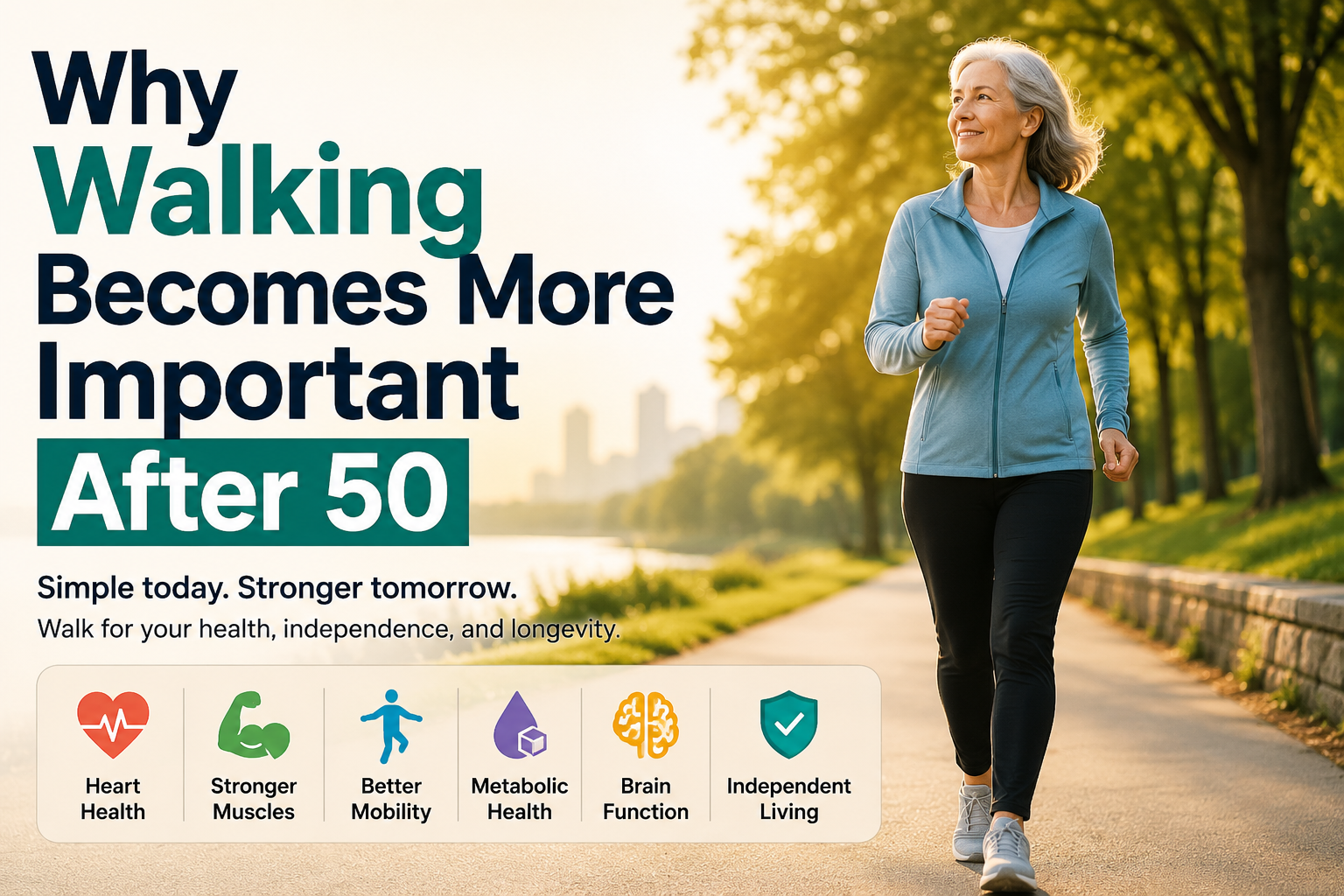
Walking is something most people learn without thinking about it.
You take a few steps to get to the kitchen.
You walk to your car.
You climb a few stairs.
You walk around the grocery store.
For most of your life, walking may feel less like exercise and more like something your body simply does.
But sometime after 50, that relationship can begin to change.
You may notice that you move a little less during the day.
A long walk feels more tiring than it used to.
You spend more time sitting at work or at home.
You may also begin paying more attention to maintaining your strength, mobility, and independence.
This is where walking becomes particularly interesting.
Walking is not a complicated form of exercise. It does not require a gym membership, specialized equipment, or advanced athletic ability.
Yet it involves several systems at the same time.
Your heart has to circulate blood.
Your lungs have to support the increased demand for oxygen.
Your muscles have to repeatedly generate force.
Your joints have to coordinate movement.
Your nervous system has to control your steps.
Your balance system has to keep you upright.
And your brain has to continuously process information about the environment.
As you get older, maintaining these systems becomes increasingly important.
That is why walking after 50 is not simply about burning calories.
It is about maintaining the physical capacity that allows you to keep doing the things you want to do.
Walking Is a Form of Whole-Body Activity
Walking looks simple because the movement is familiar.
Physiologically, however, it is surprisingly complex.
Every step requires coordination between the nervous system and the musculoskeletal system.
At the same time, your cardiovascular system adjusts to the increased demand created by movement.
Even a relatively easy walk requires repeated contractions of the muscles in your legs and trunk.
This makes walking a form of physical activity that simultaneously challenges several systems without requiring highly technical movements.
A 2023 review of research on walking and healthy aging described benefits involving cardiovascular, cerebrovascular, metabolic, cognitive, and functional health outcomes.
That broad range is one reason walking is so useful as people get older.
It does not target just one part of the body.
It repeatedly asks many systems to work together.
The Real Value of Walking After 50 Is Maintaining Capacity
There is an important difference between being able to perform an activity today and maintaining the capacity to perform it years from now.
Imagine that climbing two flights of stairs is easy for you today.
You may not think about the muscles, cardiovascular capacity, balance, and coordination required to do it.
But those abilities contribute to something larger:
Functional independence.
Functional independence means being able to perform everyday activities without needing substantial assistance.
Walking to a store.
Carrying groceries.
Getting up from a chair.
Crossing a street.
Moving around your home.
Traveling.
These activities depend on physical capacity.
Walking alone cannot preserve every component of physical function, but regular physical activity can help maintain the systems needed for everyday movement.
This is one reason walking becomes more valuable with age.
The goal is not simply to walk farther.
It is to preserve the ability to move through daily life.
Walking Supports Cardiovascular Fitness
Your cardiovascular system responds to physical activity by increasing blood flow to working muscles.
With regular activity, the body can become better conditioned to meet the demands of movement.
Walking is particularly useful because its intensity can be adjusted.
A slow walk and a brisk walk are not physiologically identical.
As walking speed increases, the demand placed on the cardiovascular system also increases.
This means walking can be adapted to different levels of fitness.
Someone beginning an activity program may start with comfortable walking.
Another person may benefit from faster walking that produces a moderate increase in breathing and heart rate.
Research examining walking and health in older adults has found associations between habitual walking and cardiovascular and other health outcomes.
But it is important to interpret these findings carefully.
A study showing that people who walk more tend to have better health does not automatically prove that walking alone caused every difference.
People who walk regularly may also differ in diet, health status, income, social activity, or other behaviors.
The evidence nevertheless supports walking as an accessible component of an active lifestyle.
Your Legs Are Doing More Than Moving You Forward
Every step is a small resistance exercise for the muscles involved in walking.
The calf muscles push against the ground.
The quadriceps help control the knee.
The hamstrings and gluteal muscles contribute to movement and stability.
The muscles around your hips and trunk help maintain your position.
Walking does not provide the same stimulus as dedicated strength training.
That distinction matters.
If the goal is to build substantial muscle strength, resistance exercise is generally more effective than walking alone.
But walking still provides repeated movement that helps maintain functional use of the lower body.
This becomes increasingly relevant when everyday mobility is the goal.
A person does not need to be able to lift a heavy weight to live independently.
They need to be able to stand, walk, turn, climb, carry, and move safely through their environment.
Walking is directly connected to those abilities.
Walking and Metabolic Health
Your muscles are major users of glucose.
When you walk, your muscles require energy, and glucose is one of the fuels they can use.
Regular physical activity can therefore influence how the body handles glucose and other aspects of metabolic health.
Walking has been associated with lower risk of metabolic diseases in observational research, and reviews have examined its relationship with conditions such as type 2 diabetes.
Again, the important word is “associated.”
Walking is not a treatment for diabetes by itself.
And a person should not stop prescribed medication because they have started walking.
Instead, walking can be one component of a broader approach to maintaining metabolic health.
The advantage is that walking can often be incorporated into ordinary life.
A walk after a meal.
Walking to a nearby destination.
Taking a longer route through a store.
Going for a walk during a break.
These small opportunities add movement without requiring a separate workout environment.
Walking Is About More Than Step Counts
The popularity of step counters has created the impression that a specific number of steps is the definition of healthy walking.
It is not that simple.
There is no universal number of daily steps that magically separates healthy people from unhealthy people.
Research examining step counts has found associations between higher levels of daily movement and better health outcomes, but the relationship is influenced by factors such as age, baseline activity, health status, and study design.
A 2026 systematic review and meta-analysis of 46 prospective studies involving more than 367,000 older adults found that walking was associated with multiple health outcomes. The researchers also found a relationship between additional daily steps and lower all-cause mortality risk, although these findings should not be interpreted as proof that a particular step count guarantees a specific health benefit.
The practical lesson is simpler:
Your current activity level matters.
If you currently walk very little, increasing your regular movement may be more meaningful than obsessing over an arbitrary step target.
Walking Helps Maintain the Skill of Moving
Walking is not just exercise.
It is also a skill.
Every time you walk, your nervous system coordinates:
- Foot placement
- Joint movement
- Muscle activation
- Balance
- Visual information
- Body position
- Forward movement
This repeated coordination helps explain why maintaining regular movement is important.
The body adapts to what it repeatedly does.
If you regularly walk, walking remains a familiar motor task.
If you become extremely inactive, you lose opportunities to practice that movement.
This does not mean that inactivity immediately causes someone to lose the ability to walk.
The change is gradual.
But maintaining movement throughout adulthood may help preserve physical function and mobility.
Walking and Balance Are Connected, But They Are Not the Same Thing
Walking and balance are closely related.
You need balance to walk.
But walking itself does not train every aspect of balance equally.
This distinction is particularly important after 50.
A person can walk several miles on a flat sidewalk and still have difficulty standing on one leg or navigating an unstable surface.
Walking-only interventions have shown benefits for walking endurance and some aspects of quality of life, but evidence for broader outcomes such as falls and balance is less consistent.
This means walking should not necessarily replace other forms of physical training.
For healthy aging, different types of movement can serve different purposes.
Walking can provide regular aerobic activity and movement practice.
Strength training can target muscular strength.
Balance exercises can challenge postural control.
Mobility exercises can address range of motion.
Together, these activities can provide a more complete physical foundation.
Walking May Also Support Brain Health
The relationship between physical activity and the brain has become an important area of research.
Walking increases physical activity and places demands on the cardiovascular system.
Researchers have therefore investigated whether walking is associated with cognitive outcomes in older adults.
A 2025 systematic review of randomized controlled trials found that walking interventions showed favorable effects on at least one cognitive domain in several studies, particularly executive function and memory, although the studies varied in their design, duration, intensity, and outcomes.
This is an area where careful language matters.
It would be inaccurate to say:
“Walking prevents dementia.”
The evidence is more nuanced.
Walking may be associated with or contribute to factors related to cognitive health, but it is not a guaranteed protection against dementia.
The research is nevertheless interesting because it suggests that the benefits of regular movement may extend beyond the muscles and cardiovascular system.
Walking Can Help Preserve Everyday Endurance
One of the first things people may notice when their physical capacity decreases is not an obvious disease.
It may simply become harder to do ordinary things.
Walking through a large store becomes tiring.
A long museum visit becomes exhausting.
A day of sightseeing requires more breaks.
A walk with friends becomes difficult.
These experiences are examples of functional endurance.
Walking regularly gives the body repeated opportunities to perform sustained, low-impact movement.
A 2024 systematic review and meta-analysis of walking-only interventions in community-dwelling older adults found improvements in walking endurance and health-related quality of life, although the certainty of evidence for the measured outcomes was rated very low.
This is an important distinction.
Walking may be particularly useful for maintaining the ability to walk.
That sounds obvious, but it is actually one of its greatest advantages.
The activity directly trains the movement you want to preserve.
Why Walking Can Be Easier to Maintain Than More Complicated Exercise
One of walking’s greatest advantages is not physiological.
It is practical.
A highly effective exercise program is not very useful if you cannot maintain it.
Walking has a relatively low barrier to entry.
You generally do not need:
- A gym membership
- Specialized equipment
- A complex training program
- Advanced athletic skills
- A large amount of preparation
You can walk alone or with someone else.
You can walk outdoors or indoors.
You can incorporate walking into transportation or daily errands.
That flexibility makes it easier to accumulate regular movement.
And consistency matters.
A modest activity that you perform regularly may be more realistic than an ambitious exercise routine that lasts for only a few weeks.
Does Walking Need to Be Brisk?
Not every walk needs to be fast.
Intensity should match your health, fitness, and purpose.
A comfortable walk can provide movement and may be a useful starting point for someone who is currently inactive.
A faster pace creates greater cardiovascular demand.
Research on brisk walking in older adults has found benefits for cardiorespiratory fitness, muscular strength, and body composition, although evidence for outcomes such as balance has been less consistent.
This means there is no reason to turn every walk into a race.
Instead, consider the purpose of the walk.
A relaxed walk may be appropriate for recovery, mobility, or simply increasing daily movement.
A brisker walk may be useful when the goal is to challenge cardiovascular fitness.
The right intensity depends on the individual.
Walking Should Not Be the Only Exercise After 50
Walking is valuable.
But walking is not a complete exercise program for everyone.
As people age, maintaining muscle strength and balance becomes increasingly important.
Walking alone may not provide enough resistance to maintain or increase strength in all major muscle groups.
This is particularly relevant for muscles that are not heavily challenged during ordinary walking.
A well-rounded physical activity routine can therefore combine walking with other forms of exercise.
For example:
Walking can provide aerobic activity.
Resistance training can target strength.
Balance exercises can challenge postural control.
Mobility work can maintain movement through available ranges.
The goal is not to choose one activity and ignore everything else.
It is to maintain the different physical abilities required for independent living.
What If You Are Currently Very Inactive?
You do not need to suddenly start walking for an hour every day.
Starting too aggressively can make the activity unnecessarily difficult.
Instead, begin with a level that is appropriate for your current physical condition.
A short walk may be enough.
You can gradually increase duration, frequency, or intensity as your body adapts.
For people with chronic health conditions, significant mobility limitations, or concerns about exercising safely, it is reasonable to discuss an appropriate activity level with a healthcare professional.
The objective is not to prove how much you can tolerate on the first day.
It is to create a sustainable pattern of movement.
Walking After 50 Is About the Future as Much as Today
This may be the most important way to think about walking.
You are not only walking to burn calories today.
You are also using your body in a way that supports continued movement.
Think about what you want to be able to do ten years from now.
Travel.
Walk through a city.
Play with grandchildren.
Carry groceries.
Walk your dog.
Climb stairs.
Get around your home independently.
These activities all depend on physical capacity.
Walking cannot guarantee that you will maintain all of these abilities.
But maintaining regular physical activity is one of the ways to support the systems that make them possible.
That makes walking less about exercise for its own sake and more about preserving options.
When Walking Becomes Difficult
A gradual decrease in walking speed or endurance can have many explanations.
But a new or unexplained change should not automatically be dismissed as aging.
Pay attention if you develop:
- New difficulty walking
- Repeated falls
- Significant dizziness
- New weakness
- Numbness
- Chest pain during activity
- Unusual shortness of breath
- A major change in exercise tolerance
- Pain that consistently limits walking
These symptoms may require medical evaluation.
In particular, sudden weakness, sudden loss of coordination, difficulty speaking, or sudden trouble walking can be signs of an emergency and require immediate medical attention.
Walking should be a tool for maintaining health, not something you are expected to push through despite concerning symptoms.
The Bottom Line
Why does walking become more important after 50?
Because walking is closely connected to the abilities that allow you to remain physically independent.
It challenges your cardiovascular system.
It repeatedly uses the muscles of your lower body.
It requires coordination between your brain and body.
It contributes to daily physical activity.
And it helps you practice one of the most important movements in everyday life:
moving from one place to another.
The value of walking is therefore bigger than the number on a step counter.
After 50, maintaining physical capacity becomes increasingly important because everyday activities depend on it.
Walking cannot prevent every age-related health problem.
It cannot replace strength training, balance exercises, medical care, or other forms of physical activity.
But it can provide a simple and sustainable foundation for staying active.
Perhaps the most useful question is not:
“How many steps should I take?”
It is:
“How much walking can I realistically keep doing?”
A walk you can maintain week after week may ultimately be more valuable than a perfect exercise plan that you abandon after a month.
Walking is simple.
But maintaining the ability to walk well may be one of the most useful investments you can make in your future mobility.
Medical Disclaimer: This article is provided for general educational and informational purposes only. It is not intended to provide medical diagnosis, treatment, or personalized medical advice. Physical activity should be appropriate for an individual’s health and fitness level. If you have a medical condition, significant mobility limitations, or new symptoms such as chest pain, unusual shortness of breath, sudden weakness, or sudden difficulty walking, consult an appropriate healthcare professional or seek urgent medical attention when necessary.