Have you ever noticed that something that once felt manageable now seems much more exhausting?
Maybe a busy week at work used to feel normal. Now, the same workload leaves you mentally drained for days.
Perhaps you can handle a stressful situation during the day, but later that night you find yourself thinking about it over and over again.
Or maybe you simply feel like you do not recover from stress as quickly as you did when you were younger.
If this sounds familiar, you may have wondered:
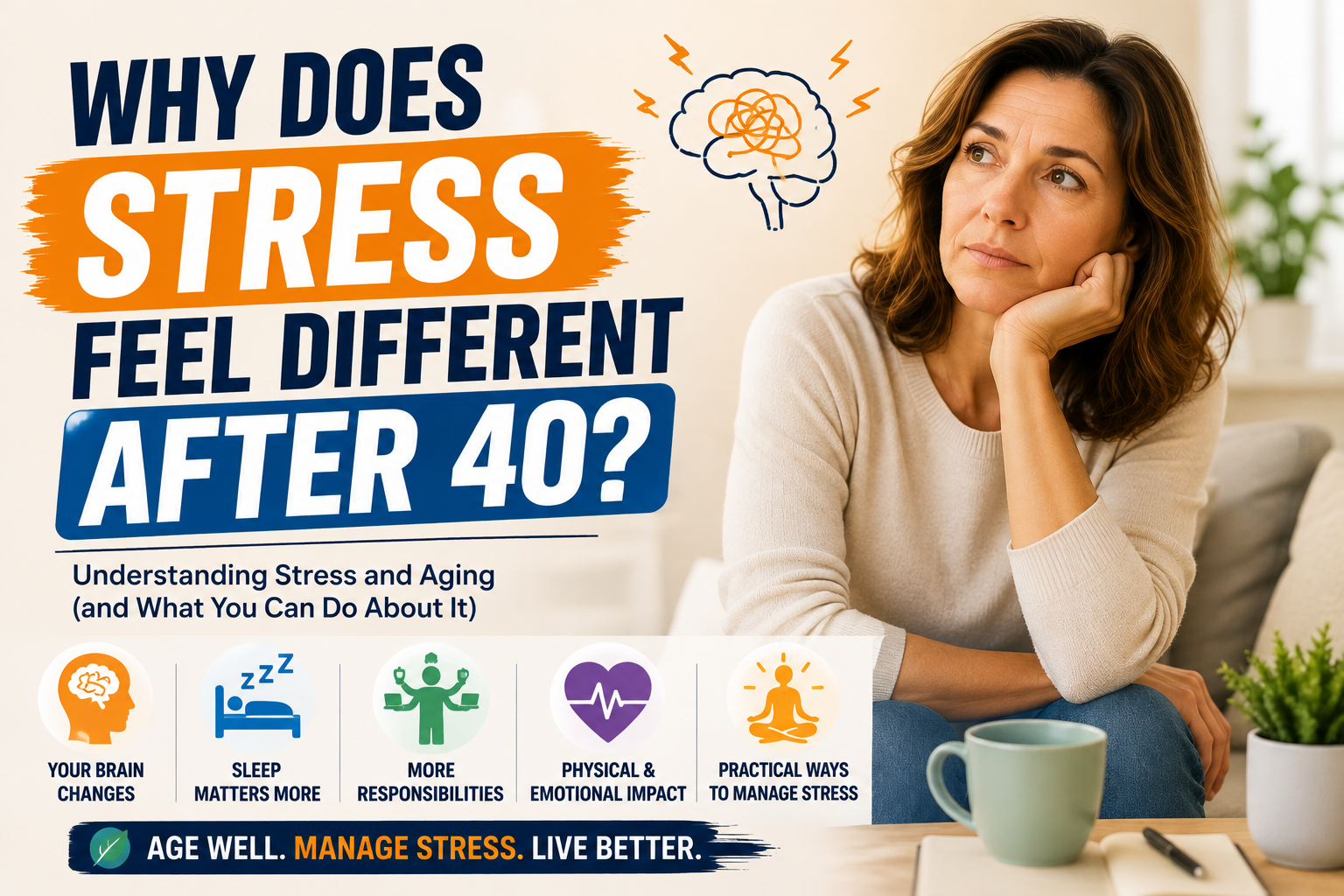
Why does stress feel different after 40?
Getting older does not automatically mean that you become less capable of handling stress. In fact, many people become better at understanding their emotions, setting boundaries, and putting stressful events into perspective as they age.
At the same time, aging, sleep changes, physical health, hormones, daily responsibilities, and years of accumulated experiences can all influence how stress is experienced.
The relationship between stress and aging is complex. Researchers have found that the body’s stress-response system can change across adulthood, while psychological resilience, emotional regulation, and social support can influence how people respond to stress.
Understanding these changes can help you approach stress differently after 40.
What Actually Happens to Stress After 40?
There is no specific age at which your body suddenly starts handling stress differently.
Your experience of stress depends on many factors, including your physical health, sleep, lifestyle, relationships, work, financial situation, and previous experiences.
However, the body’s systems involved in the stress response can change as we age.
One important system is the hypothalamic-pituitary-adrenal (HPA) axis. This system helps your body respond to physical and psychological stress and involves the release of hormones including cortisol.
Cortisol is sometimes called the “stress hormone,” but that description can be misleading.
Cortisol is not inherently bad.
It plays important roles in metabolism, immune function, blood pressure regulation, and helping the body respond to challenges.
The problem is more complicated when stress becomes frequent or prolonged and the body’s stress-response system does not have enough opportunity to recover.
Research on aging and the HPA axis suggests that patterns of cortisol secretion and stress regulation can change with age, although the exact changes vary between individuals and studies.
So rather than thinking:
“I turned 40, and now stress affects me differently.”
It may be more accurate to think:
“Several changes in my body and life are happening at the same time, and they may be changing how I experience stress.”
1. You May Have More Sources of Stress Than You Did in Your 20s
One obvious reason stress can feel different after 40 has nothing to do with a single biological change.
Your life may simply be more complicated.
In your 20s, your main concerns might have involved school, starting a career, dating, or finding your direction.
By your 40s and 50s, you may be balancing several responsibilities simultaneously.
You may be:
- Managing a demanding career
- Raising children
- Supporting aging parents
- Managing a mortgage or other financial responsibilities
- Thinking about retirement
- Dealing with relationship changes
- Managing your own health
- Trying to maintain friendships and social connections
None of these things is necessarily a problem by itself.
The challenge is that they can happen at the same time.
A stressful event that would have been easy to handle on its own can feel much heavier when it is added to an already full schedule.
This is one reason why stress after 40 may feel less like a single dramatic event and more like a constant background pressure.
2. Recovery From Stress May Become More Important
When you are younger, you may be able to stay up late, work through a stressful day, sleep for a few hours, and feel relatively normal again the next morning.
That experience can change.
Sleep patterns commonly change with age, and older adults may experience lighter sleep and more nighttime awakenings. These changes can make it harder to feel fully recovered after a stressful day.
Stress and sleep can also influence each other.
You experience stress.
You sleep poorly.
The next day you are tired.
Because you are tired, everyday problems feel more difficult.
Then you become more stressed.
This creates a cycle that can be difficult to break.
Research in older adults has found associations between fragmented sleep and daytime cortisol levels, although these studies cannot establish that one directly causes the other.
This is why protecting sleep becomes an important part of stress management after 40.
3. Your Body’s Stress Response Can Change With Age
When something stressful happens, your body reacts.
Your heart rate can increase.
Your muscles become more prepared for action.
Hormones are released.
Your attention becomes focused on dealing with the situation.
This response is useful when you need to react quickly.
The problem comes when your body repeatedly activates this system without enough recovery.
Research examining aging and the HPA axis suggests that some aspects of stress regulation can change across the lifespan. Some studies have reported age-related differences in cortisol patterns, although the findings are not simple enough to say that every person becomes more stress-reactive after 40.
This distinction is important.
If you are feeling more stressed after 40, it does not necessarily mean your body is “failing.”
It may reflect the interaction between your biology and everything else happening in your life.
4. Stress Can Feel More Physical
Have you noticed that stress sometimes shows up in your body before you even recognize that you are worried?
You might experience:
- Muscle tension
- Headaches
- Trouble sleeping
- Changes in appetite
- Fatigue
- Difficulty concentrating
- Feeling restless
- A faster heartbeat
These symptoms can make stress feel more physical than emotional.
And once you notice a physical symptom, you may become worried about the symptom itself.
For example:
Stress → poor sleep → fatigue → worry about fatigue → more stress
This does not mean that every physical symptom is caused by stress.
Persistent or unexplained symptoms should always be discussed with an appropriate healthcare professional.
But understanding the connection between mental and physical well-being can help explain why stress sometimes feels different as you get older.
5. You May Become More Sensitive to Poor Sleep
Sleep is particularly important when thinking about stress after 40.
If you regularly wake during the night or do not feel refreshed in the morning, you may have less energy available to deal with everyday challenges.
Imagine two people receiving the same stressful email at 10 AM.
One slept well and feels rested.
The other slept poorly and woke several times during the night.
The event is identical.
Their experience of the event may not be.
The second person may have less patience, less concentration, and fewer emotional resources available to deal with the problem.
This is one reason that stress management is not only about meditation or relaxation.
Sleep is part of stress management.
The National Institute on Aging recommends healthy sleep habits and notes that managing stress, getting enough sleep, and staying physically active can support physical and emotional health as people age.
6. Your Perspective on Stress May Actually Improve
There is also a positive side to getting older.
Not every change after 40 is negative.
With age and experience, many people become better at recognizing which problems actually deserve their attention.
You may become more comfortable saying:
“This is not worth worrying about.”
You may also become better at recognizing patterns.
After experiencing difficult situations before, you may know that an uncomfortable period will eventually pass.
This ability to regulate emotions and put stressful experiences into perspective is one component of psychological resilience.
Research on aging and stress has examined the roles of emotional regulation and social support in resilience among older adults.
In other words, you may not necessarily have less stress after 40.
You may simply become better at deciding what deserves your emotional energy.
7. Social Connections Can Change How You Handle Stress
Another important factor is social support.
When life becomes busy, maintaining friendships can become surprisingly difficult.
Work gets busier.
Children need attention.
Parents may need more support.
Free time becomes limited.
You may gradually find yourself talking to fewer people about what is bothering you.
That can make stress feel heavier.
Social relationships can provide emotional support, practical help, and a sense of connection.
Research examining stress and resilience in older adults has found that social support and emotional regulation are important factors in how people adapt to stress.
This does not mean you need a huge social circle.
One or two people you can speak honestly with may be more valuable than dozens of casual connections.
8. Chronic Stress Is Different From an Occasional Bad Day
Everyone experiences stress.
A difficult meeting, traffic jam, family disagreement, or unexpected bill does not automatically mean you are experiencing harmful chronic stress.
The bigger concern is ongoing stress without sufficient recovery.
For example:
You wake up stressed.
You work while stressed.
You come home thinking about work.
You sleep poorly because you are thinking about tomorrow.
You wake up tired and start the cycle again.
When this continues for a long time, it can affect your overall well-being.
Research into aging and stress suggests that long-term stress exposure and changes in stress-regulation systems may interact with health as people age. However, the relationship is complex and cannot be reduced to one hormone or one cause.
This is why the goal should not be to eliminate every stressful event from your life.
That is impossible.
The goal is to create enough recovery between stressful events.
9. How to Manage Stress Better After 40
You do not need to completely change your life to start managing stress differently.
Start with a few basic habits.
Protect your sleep
Try to maintain a consistent sleep and wake schedule.
If you have persistent sleep problems, do not assume that they are simply a normal part of aging.
Move your body regularly
Physical activity can support physical and emotional health and is one of the strategies recommended by the NIA for managing stress and maintaining health as you age.
You do not necessarily need intense exercise.
Walking, strength training, cycling, swimming, and other activities can all be ways to stay active.
Create a transition between work and home
If possible, give yourself a short period between work and personal life.
Take a walk.
Listen to music.
Take a shower.
Sit quietly for ten minutes.
The purpose is to give your mind a signal that the workday has ended.
Reduce unnecessary decisions
Constant decision-making can be mentally exhausting.
Preparing meals in advance, organizing your schedule, or establishing simple routines can reduce the number of small decisions you have to make every day.
Stay connected
Make time for people you trust.
A conversation with a friend or family member can sometimes provide perspective that you cannot find while thinking about a problem alone.
Learn to distinguish urgent from important
Not everything that feels urgent deserves immediate emotional attention.
Before reacting, ask:
“Will this still matter six months from now?”
Sometimes the answer changes how you approach the situation.
10. When Stress May Need More Attention
Feeling stressed occasionally is normal.
But persistent stress should not simply be ignored.
Consider talking with a healthcare or mental health professional if stress is consistently interfering with your sleep, work, relationships, concentration, or ability to manage everyday activities.
It is particularly important to seek professional help if you experience persistent feelings of hopelessness, severe anxiety, major changes in sleep or appetite, or thoughts of harming yourself.
You do not have to wait until stress becomes overwhelming before asking for help.
Seeking support is not a sign that you cannot handle life.
It can be part of handling life more effectively.
The Bottom Line
So, why does stress feel different after 40?
There is no single answer.
Your body changes as you age, but your life also changes.
You may have more responsibilities, less time for recovery, different sleep patterns, and new concerns about health, family, finances, or the future.
At the same time, you may gain something valuable: experience.
You may become better at recognizing unnecessary stress, regulating your emotions, setting boundaries, and understanding which problems deserve your attention.
The goal after 40 is not to live a completely stress-free life.
Instead, focus on becoming better at recovering from stress.
Protect your sleep.
Stay physically active.
Maintain meaningful relationships.
Create time to decompress.
And pay attention when stress starts affecting your everyday life.
Getting older does not necessarily mean that you have to become more stressed.
It can also be an opportunity to become more intentional about where you spend your energy.
Medical Disclaimer: This article is intended for general informational purposes only and is not a substitute for professional medical advice, diagnosis, or treatment. If persistent stress is affecting your mental or physical health, sleep, relationships, or daily activities, consider speaking with a qualified healthcare or mental health professional.