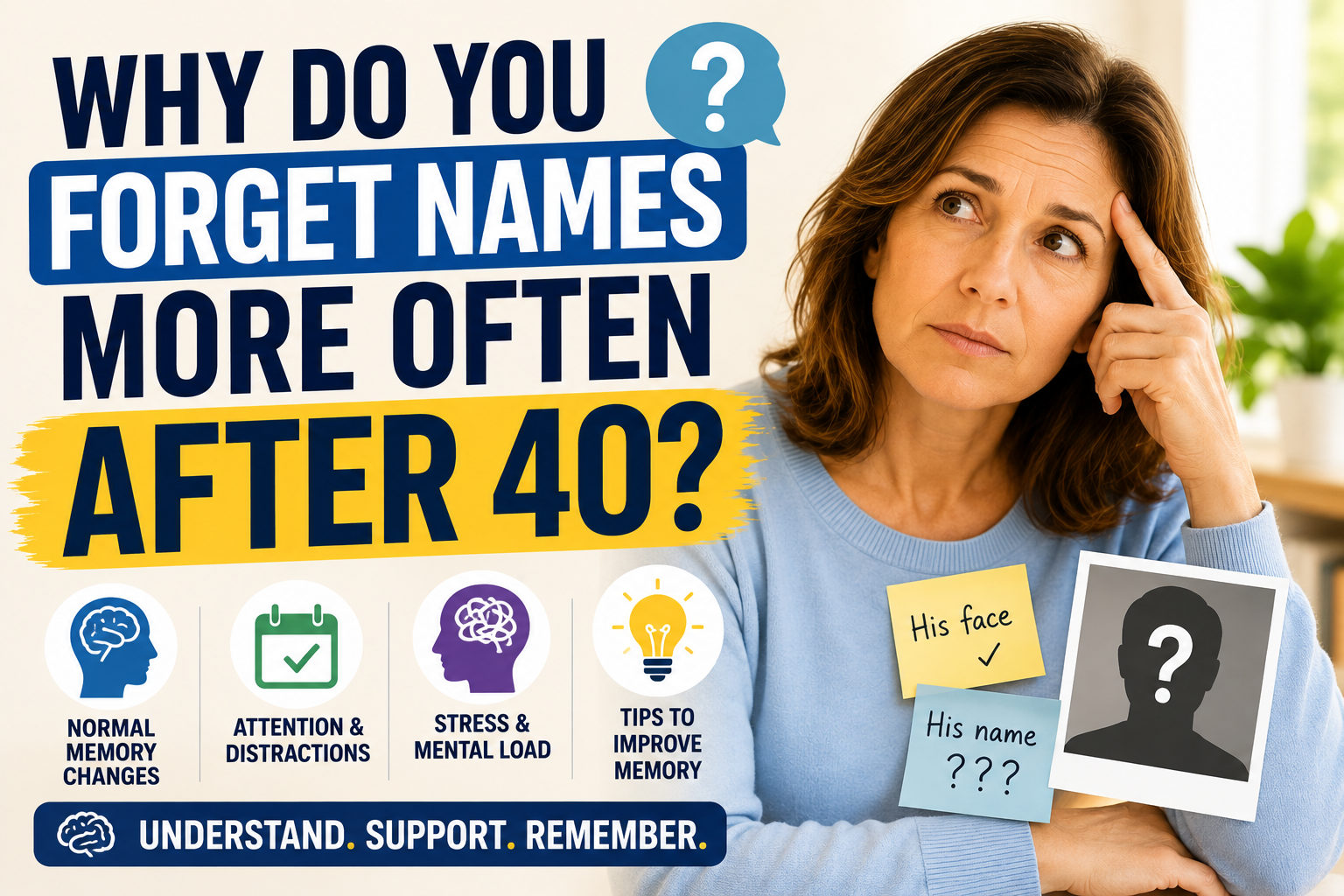
Have you ever met someone you know, smiled, and immediately realized that you could not remember their name?
You know their face.
You remember where you met them.
You may even remember what they do for a living.
But their name simply will not come to you.
Then, sometimes an hour later, the name suddenly appears in your mind.
If this happens more often after 40, you may start wondering:
“Why am I forgetting people’s names?”
The good news is that occasionally forgetting a name does not automatically mean that your memory is failing. Some changes in memory and the speed at which we recall information can occur as we age. The National Institute on Aging explains that occasional forgetfulness can be a normal part of aging.
However, there is an important difference between occasionally struggling to remember a name and having memory problems that interfere with everyday life.
Understanding that difference can help you know when there is probably no reason to worry and when it may be worth talking with a healthcare professional.
Why Do You Forget Names More Often After 40?
Forgetting a person’s name can feel surprisingly frustrating because names are a very specific type of information.
When you meet someone, your brain has to pay attention to their face, listen to their name, connect the name with the person, and then store and retrieve that information later.
If your attention is divided when you first meet someone, the name may never be stored particularly strongly in the first place.
This is one reason why you might remember someone’s face but forget their name.
It does not necessarily mean that the memory itself has disappeared.
Sometimes the information is simply harder to retrieve.
1. Your Brain May Take Longer to Retrieve Information
One of the most noticeable changes in memory as people get older is that recalling information can sometimes take longer.
You may know the answer, but it does not immediately come to mind.
This is often described as a “tip-of-the-tongue” experience.
You might think:
“I know this person’s name.”
“I’ve known them for years.”
“Why can’t I remember it right now?”
A few minutes later, the answer suddenly appears.
Research discussed by the National Institute on Aging indicates that some healthy older adults may take longer to remember information or learn something new, even though many cognitive abilities remain strong.
So the difference may not always be that your brain has completely lost the information.
Sometimes it simply takes longer to retrieve it.
2. You May Not Be Paying Enough Attention When You Meet Someone
This is one of the most overlooked reasons for forgetting names.
Imagine that you are introduced to someone at a crowded dinner.
You hear:
“Hi, I’m David.”
But at the same time:
Someone else is talking.
Music is playing.
You are thinking about what to say next.
You are wondering where you parked your car.
You smile, shake hands, and continue the conversation.
Five minutes later, you cannot remember the person’s name.
In this situation, the problem may have started with attention rather than memory.
Your brain cannot reliably remember information that it never properly registered.
This is particularly important as our daily lives become more distracting.
If you want to remember someone’s name, pause for a moment when they introduce themselves.
Look at them.
Listen carefully.
Then use their name naturally during the conversation.
For example:
“Nice to meet you, David.”
That simple repetition gives your brain another opportunity to connect the person’s face with their name.
3. Stress Can Make Your Memory Feel Worse
Stress can affect concentration and attention.
If your mind is occupied with work, finances, family responsibilities, or other worries, you may have less attention available for remembering new information.
You might therefore experience more moments of:
“What was that person’s name?”
“What did I come into this room for?”
“Where did I put my keys?”
This does not necessarily mean that stress is permanently damaging your memory.
It may simply make it harder to concentrate and retrieve information when you need it.
For people in their 40s and 50s, this can be especially noticeable because this stage of life can involve multiple responsibilities at the same time.
If you are constantly multitasking, your brain may have difficulty giving full attention to any single piece of information.
4. Poor Sleep Can Affect Memory and Concentration
Sleep is another important piece of the puzzle.
If you regularly sleep poorly, you may notice that your attention and concentration are not as sharp during the day.
That can make remembering names more difficult.
This is particularly relevant if you have also noticed changes such as waking frequently during the night, feeling tired during the day, or having difficulty concentrating.
Sleep problems can have many causes, and persistent sleep difficulties should not simply be dismissed as a normal part of getting older.
If you have been following our Healthy Aging After 40 series, this is one reason why memory and sleep are closely connected topics.
Your brain does not operate separately from the rest of your body.
5. Why Faces Can Be Easier to Remember Than Names
There is a reason the following situation can feel so strange:
“I know exactly who you are. I just can’t remember your name.”
A person’s face contains a great deal of visual information.
Their name, on the other hand, may be an arbitrary label.
For example, there is nothing about the name “Michael” that visually tells your brain that the person standing in front of you is Michael.
This means that recognizing someone’s face and retrieving their name are not exactly the same mental task.
You can therefore recognize a familiar person while temporarily struggling to retrieve their name.
Occasional experiences like this can occur as part of normal age-related forgetfulness.
6. Are You Actually Forgetting More, or Just Noticing It More?
There is another interesting possibility.
You may have forgotten names throughout your life.
The difference is that you may notice it more now.
At 25, forgetting the name of someone you met once might not seem unusual.
At 45, the same experience can trigger a different thought:
“Is my memory getting worse?”
That concern can make ordinary memory lapses feel much more significant.
Occasional forgetfulness is common, and the National Institute on Aging specifically distinguishes mild age-related forgetfulness from more serious memory problems.
The important thing is to look for patterns, rather than judging your memory based on one forgotten name.
Normal Forgetfulness vs. Memory Problems
So how can you tell the difference?
Examples of occasional, normal forgetfulness may include:
- Forgetting someone’s name temporarily
- Occasionally forgetting where you left your keys
- Sometimes struggling to find the right word
- Forgetting an appointment but remembering it later
- Occasionally making a decision you later realize was not ideal
These kinds of experiences can occur during normal aging.
The situation is different when memory problems become frequent and begin interfering with everyday activities.
For example:
- Asking the same questions repeatedly
- Getting lost in a place you know well
- Having difficulty following familiar instructions
- Frequently forgetting important events
- Having trouble managing bills or other routine responsibilities
- Becoming increasingly confused about dates, people, or places
- Frequently misplacing things and being unable to retrace your steps
These are more concerning patterns and are worth discussing with a healthcare professional.
The key distinction is not simply how often you forget something.
It is also whether the changes interfere with your ability to function normally.
Does Forgetting Names Mean You Have Dementia?
No.
Forgetting names occasionally does not mean that you have dementia.
Dementia is not simply normal forgetfulness that becomes slightly worse with age. It involves a decline in cognitive abilities that is significant enough to interfere with everyday life.
Memory problems can also have many different causes.
The National Institute on Aging notes that some memory difficulties may be related to factors other than dementia, including certain medical conditions, medications, depression, and other health issues.
That is why it is not a good idea to diagnose yourself based on a few forgotten names.
If you are concerned about a noticeable change in your memory, a healthcare professional can evaluate your symptoms and look for possible causes.
What Can You Do to Remember Names More Easily?
If your biggest problem is remembering people’s names, there are several simple strategies you can try.
Repeat the name
When someone introduces themselves, use their name naturally during the conversation.
“It’s great to meet you, Sarah.”
This gives you another opportunity to connect the name with the person.
Connect the name with something memorable
Try creating a mental association.
If you meet someone named Rose who loves gardening, you might connect “Rose” with flowers.
The more meaningful the association, the easier the name may be to retrieve later.
Focus when the person introduces themselves
Avoid thinking about what you are going to say next.
For a few seconds, simply pay attention to the person’s name.
Write it down
If you meet several new people at work or an event, writing down their names afterward can help reinforce the information.
Use context
Connect the person’s name with where you met them.
For example:
“James — neighbor from the Saturday community event.”
Now you have multiple pieces of information connected to the same person.
Get enough sleep
Good sleep supports attention and overall cognitive function.
If poor sleep is making it difficult to concentrate during the day, addressing your sleep habits may help your memory feel more reliable as well.
When Should You Talk to a Doctor?
Occasionally forgetting a name is usually not enough by itself to indicate a serious problem.
However, if you notice that your memory is changing significantly or that problems are interfering with your everyday life, it is worth talking with a healthcare professional.
The National Institute on Aging recommends discussing noticeable changes in memory or thinking with a doctor.
It can be helpful to write down specific examples before your appointment.
Instead of saying:
“My memory is terrible.”
Try:
“I have forgotten the same information several times this month.”
Or:
“I recently got lost while driving somewhere I have visited many times.”
Specific examples can help a healthcare professional understand what has changed.
What About Mild Cognitive Impairment?
You may also hear the term Mild Cognitive Impairment, or MCI.
MCI involves more noticeable problems with memory or thinking than would normally be expected for someone of the same age, but it does not necessarily prevent the person from carrying out everyday activities independently.
People with MCI may have problems such as frequently losing things, forgetting appointments, or having more difficulty finding words than other people their age.
Importantly, MCI does not automatically mean that someone has dementia.
A healthcare professional can evaluate memory and thinking problems and determine whether further assessment is appropriate.
Simple Ways to Support Brain Health After 40
There is no single trick that can guarantee perfect memory.
Instead, focus on overall health.
Regular physical activity, adequate sleep, staying socially connected, managing stress, eating a balanced diet, and keeping your brain engaged are all reasonable parts of a healthy aging lifestyle.
The goal is not to remember every name perfectly.
The goal is to maintain your overall ability to think, learn, communicate, make decisions, and handle everyday activities as you age.
The Bottom Line
So, why do you forget names more often after 40?
There is not necessarily one reason.
As you age, retrieving information can sometimes take longer. At the same time, stress, poor sleep, distractions, and lack of attention can make ordinary memory lapses more noticeable.
Forgetting someone’s name once in a while does not automatically mean that your memory is failing.
In fact, you may remember the person’s face, where you met them, and what you talked about while simply needing a little more time to retrieve their name.
The more important question is whether your memory changes are becoming frequent, progressive, or disruptive to everyday life.
If you occasionally think, “I know this person’s name, but I just can’t remember it right now,” there may be no reason to panic.
Take a breath.
Give your brain a moment.
The name may come back.
And if you notice broader changes in memory or thinking that concern you, don’t simply assume that they are a normal part of getting older. Talking with a healthcare professional is the best way to understand what may be happening.
Medical Disclaimer: This article is intended for general informational purposes only and is not a substitute for professional medical advice, diagnosis, or treatment. If you have concerns about changes in your memory or thinking, particularly if they interfere with your daily activities, consult a qualified healthcare professional.