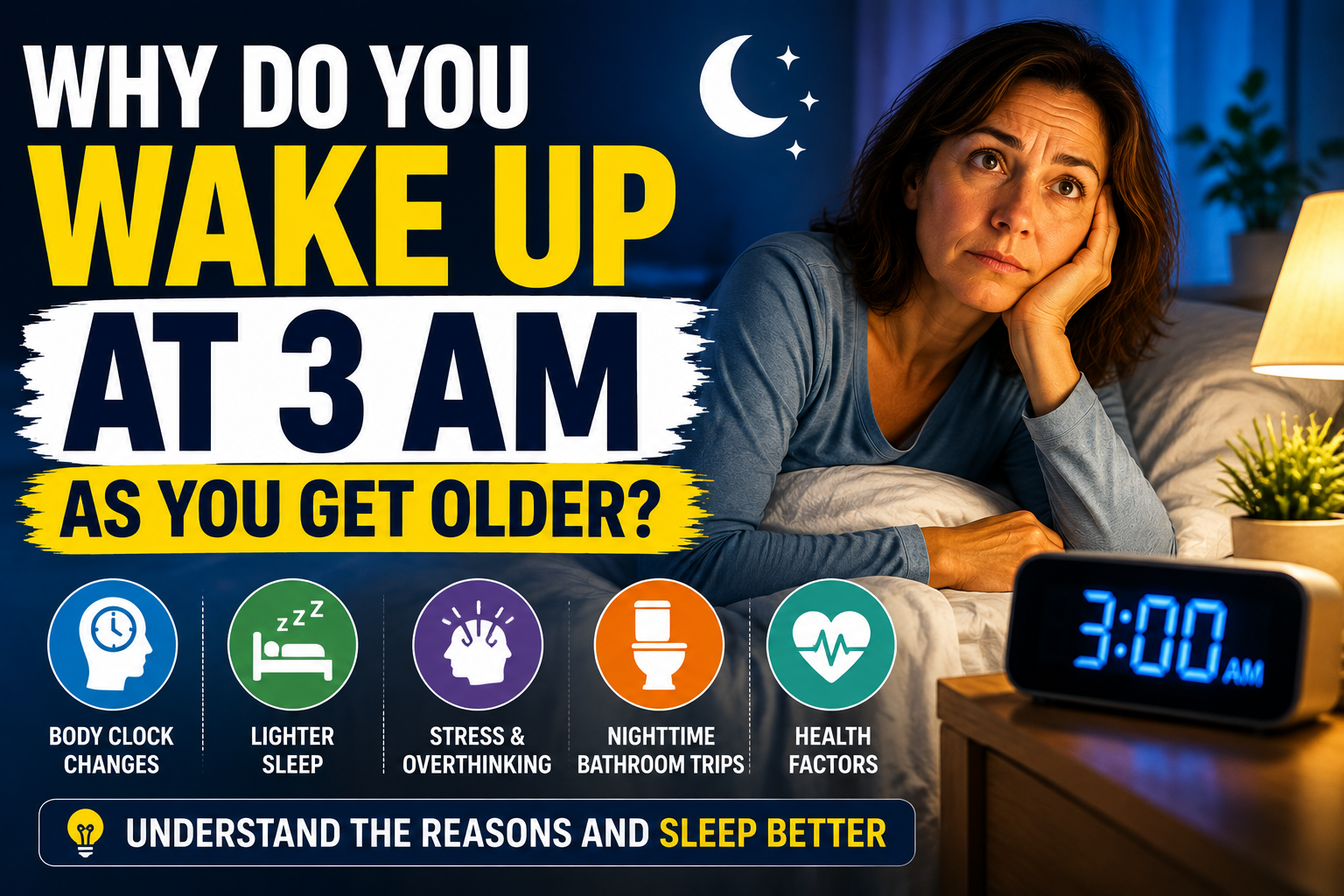
You fall asleep without much trouble, but then you suddenly wake up.
You look at the clock.
3:00 AM.
You try to go back to sleep, but your mind starts working. You think about tomorrow’s schedule, work, family, or something that happened earlier in the day. Before you know it, another 30 minutes have passed.
If this happens regularly, you may wonder:
Why do I keep waking up at 3 AM?
This becomes a particularly common question as people get older. Sleep naturally changes with age, but waking up at 3 AM does not necessarily mean that something is wrong.
In many cases, several small changes in your sleep pattern, body clock, lifestyle, and overall health can come together to make nighttime awakenings more noticeable.
Is Waking Up at 3 AM a Normal Part of Aging?
To some extent, yes.
As you get older, your sleep tends to become lighter and more fragmented. The National Institute on Aging explains that older adults often go to bed earlier, wake earlier, and may wake more frequently during the night. The amount of time spent in different stages of sleep also changes with age.
This means that you may not sleep as continuously as you did when you were younger.
You might sleep for several hours, briefly wake up, fall asleep again, and repeat the process throughout the night.
The important point is that 3 AM itself is not a magical or dangerous time for your body.
Your brain does not suddenly decide at exactly 3 AM that it is time to wake up.
Instead, the timing may reflect the interaction between your sleep cycles, your biological clock, your environment, and other factors affecting your sleep.
1. Your Body Clock Changes as You Age
One of the biggest reasons for changes in sleep after 40 is your circadian rhythm, sometimes called your body clock.
Your circadian rhythm helps regulate when you feel sleepy and when you feel awake. Light and darkness are important signals that help keep this internal clock synchronized with the 24-hour day.
As people get older, the timing and strength of these biological rhythms can change.
The NHLBI notes that older adults tend to go to sleep earlier and wake earlier than younger adults.
Imagine that you used to sleep from 11 PM to 7 AM.
As you get older, your body may gradually shift toward something like 10 PM to 6 AM.
If you still go to bed at 10 PM but your body naturally wants to wake earlier, you may find yourself awake at 3 or 4 AM.
Your sleep schedule may have changed even though your bedtime routine has not.
2. Deep Sleep Decreases With Age
Another important factor is deep sleep.
Sleep is divided into different stages, and deep or slow-wave sleep is the deepest stage of non-REM sleep.
The amount of deep sleep generally declines as people age. NHLBI explains that deep slow-wave sleep decreases across adulthood.
This can make your sleep feel lighter.
When you were younger, you might have slept through a noisy street, a partner moving around, or a pet making noise.
Later in life, the same disturbance may wake you.
Once you wake up, you may become more aware of the fact that it is 3 AM.
That does not necessarily mean you have developed insomnia. Occasional nighttime awakenings can happen to anyone.
The bigger question is whether you can return to sleep and whether the problem is affecting your daytime life.
3. Stress Can Make 3 AM Feel Like the Worst Time of Night
There is another reason waking up at 3 AM can be so frustrating: your mind is suddenly awake while the rest of the world is quiet.
During the day, you have work, conversations, errands, television, phones, and other distractions.
At 3 AM, there is usually nothing competing for your attention.
That can make worries feel much bigger than they did during the day.
You might start thinking:
“Why can’t I sleep?”
Then:
“I have to wake up in four hours.”
Then:
“Tomorrow is going to be terrible.”
This creates a cycle in which worrying about sleep makes it even harder to fall asleep.
Stress and emotional difficulties can contribute to fatigue and sleep problems, and major life changes can make nighttime sleep more difficult.
If your mind immediately becomes active when you wake up, the problem may not be the initial awakening itself. The problem may be what happens afterward.
4. Your Evening Habits Can Contribute to Nighttime Awakenings
Your nighttime routine can also influence how well you sleep.
Consider your habits during the several hours before bedtime.
Do you drink coffee late in the afternoon?
Do you drink alcohol in the evening?
Do you take a long nap after dinner?
Do you eat a very large meal close to bedtime?
Do you spend a lot of time looking at your phone in bed?
These habits do not affect everyone in exactly the same way, but they can interfere with sleep for some people.
The National Institute on Aging recommends maintaining a consistent sleep schedule, limiting late-day naps, avoiding caffeine and alcohol late in the day, exercising regularly, and keeping the bedroom comfortable and quiet.
Instead of changing everything at once, try changing one habit for a couple of weeks and observe whether your sleep improves.
5. Getting Up to Use the Bathroom Can Break Your Sleep
Another surprisingly common reason for waking during the night is the need to urinate.
As people get older, nighttime bathroom trips can become more common.
The problem is not always the bathroom trip itself.
You may wake up, get out of bed, turn on the lights, check the time, and then return to bed fully awake.
If you were already in a lighter stage of sleep, this small interruption may be enough to keep you awake for a while.
If nighttime urination happens frequently, it is worth discussing with a healthcare professional rather than simply assuming that it is an unavoidable part of aging.
6. For Women, Menopause Can Affect Sleep
For women in midlife, hormonal changes can be another important factor.
During the menopausal transition, some women experience hot flashes and night sweats that can interrupt sleep. The National Institute on Aging also notes that mood changes and the need to urinate can contribute to nighttime waking during this period.
You may not even remember a hot flash clearly.
You might simply notice:
“I keep waking up around 3 AM.”
If nighttime awakenings began around the same time as other menopausal symptoms, it may be useful to consider whether the two are connected.
7. Sometimes 3 AM Waking Can Be a Sign of a Sleep Problem
Although nighttime awakening can be a normal part of aging, persistent sleep problems should not always be dismissed as “getting older.”
Insomnia can include waking frequently during the night or waking too early and being unable to fall back asleep. NHLBI identifies early morning awakening and difficulty returning to sleep as common symptoms of insomnia.
Sleep apnea is another possibility.
People with sleep apnea may repeatedly stop and restart breathing during sleep. Symptoms can include loud snoring, gasping for air, daytime sleepiness, dry mouth, morning headaches, and repeated nighttime awakenings.
One challenge is that you may not remember every breathing interruption.
If you regularly wake up exhausted despite spending enough time in bed, especially if someone tells you that you snore loudly or stop breathing during sleep, consider discussing these symptoms with a healthcare professional.
8. What Should You Do When You Wake Up at 3 AM?
The first thing is not to panic.
Waking up once during the night does not mean that you have insomnia.
Try to avoid immediately checking your phone.
The bright light and stimulating content can make it harder to become sleepy again. Instead, keep the room dark and comfortable.
If you feel relaxed and sleepy, simply remain in bed and allow yourself to return to sleep.
If you are wide awake and becoming increasingly frustrated, a quiet, relaxing activity in dim light may be more helpful than repeatedly checking the clock.
Most importantly, avoid turning the clock into an enemy.
Seeing:
3:02 AM → 3:17 AM → 3:41 AM
can create anxiety about how much sleep you have left.
Your goal is not to force yourself to sleep.
Your goal is to create conditions that allow sleep to return naturally.
9. Focus on Your Entire Sleep Schedule
If you repeatedly wake up at 3 AM, do not focus only on those few minutes.
Look at your entire day.
Ask yourself:
- What time do I wake up every morning?
- What time do I usually go to bed?
- Do I nap during the day?
- How much caffeine do I drink?
- Do I exercise regularly?
- Do I spend enough time outside during daylight?
- Do I drink alcohol in the evening?
- How stressed have I been recently?
- Do I feel sleepy or exhausted during the day?
Keeping a simple sleep diary for a couple of weeks can help you identify patterns.
For example, you may discover that your 3 AM awakenings happen mostly after late afternoon naps or on days when you drink coffee later than usual.
The pattern may be more useful than the exact time on the clock.
When Should You Talk to a Healthcare Professional?
Occasionally waking up at 3 AM is usually not a reason to worry.
However, frequent nighttime awakenings deserve more attention when they continue for weeks or begin affecting your daily life.
Consider speaking with a healthcare professional if you regularly:
- Have difficulty returning to sleep
- Feel exhausted during the day
- Have significant daytime sleepiness
- Snore loudly
- Wake up gasping or choking
- Experience frequent nighttime urination
- Have persistent changes in your sleep
- Have symptoms that began after starting a medication
The NIA recommends talking with a doctor when tiredness continues for more than two to three weeks, particularly when it interferes with normal activities.
The Bottom Line
So, why do you wake up at 3 AM as you get older?
There is no single answer.
Your body clock may shift toward an earlier sleep schedule. You may spend less time in deep sleep and experience lighter, more fragmented sleep. Stress, evening habits, nighttime urination, menopause, medications, and sleep disorders can also contribute.
The good news is that waking up during the night does not automatically mean that something is wrong.
Instead of worrying about the exact time you wake up, pay attention to the bigger picture:
How often does it happen? Can you fall back asleep? And how do you feel the next day?
As you move through your 40s, 50s, and beyond, your sleep may not look exactly the way it did when you were younger. That is a normal part of healthy aging for many people.
But persistent poor sleep is not something you simply have to accept because you are getting older.
Understanding your changing sleep patterns is the first step toward improving them.
Medical Disclaimer: This article is for general informational purposes only and is not a substitute for professional medical advice, diagnosis, or treatment. If you have persistent sleep problems, excessive daytime sleepiness, breathing problems during sleep, or other concerning symptoms, consult a qualified healthcare professional.